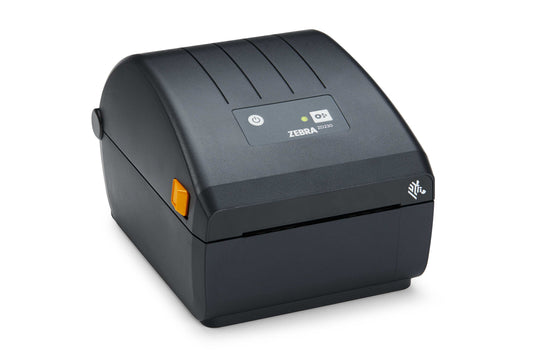
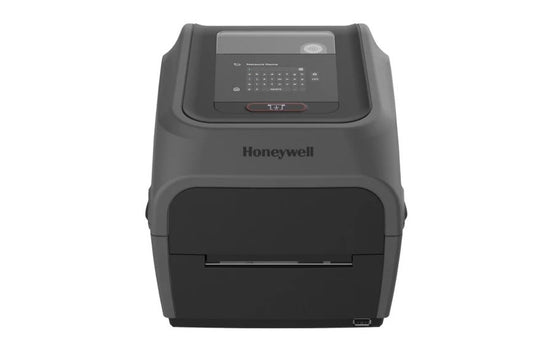
Under the EU CLP Regulation (EC 1272/2008), which implements the UN GHS system, hazardous substances and mixtures must carry a label with the correct pictograms, signal word, hazard and precautionary statements — and that label has to stay readable for as long as the container is in use. This page collects the printers we stock that are suited to producing those labels in-house.
Why thermal transfer, not direct thermal
Every printer on this page is a thermal transfer model. That is the key requirement: direct thermal labels darken and fade when exposed to heat, sunlight, solvents or prolonged storage, which is exactly what a chemical drum label faces. Thermal transfer prints through a ribbon onto the label surface, and with the right combination it survives.
For chemical labelling that combination is typically a synthetic label material (polypropylene or polyester rather than paper) with a resin or wax-resin ribbon. Paper labels and standard wax ribbons are not suitable for containers that may be exposed to chemicals, moisture or UV.
Which printer for your labelling?
| Label width needed |
Recommended |
Typical use |
| Up to 104 mm (4") |
Zebra ZD230t, ZD421t, ZD621t, Honeywell PC45t / PC42E-T, Citizen CL-S621 |
Smaller containers, bottles, canisters and secondary packaging |
| Up to 104 mm, high volume |
Zebra ZT111, ZT231, ZT411, Honeywell PD45 / PM45, Citizen CL-E720 |
Production lines and continuous labelling of drums and canisters |
| Up to 168 mm (6") |
Zebra ZT421 |
Large drum and IBC labels where the full GHS panel must fit on one label |
Pictogram size matters
CLP sets minimum dimensions for the label and its pictograms depending on the package volume — larger containers require larger labels and larger diamonds. This is the practical reason a 6-inch printer is often needed for drums and IBCs: the required panel simply doesn't fit on a 4-inch label. Check the size requirements for your package volumes before choosing a print width.
Also plan for resolution: 203 dpi is enough for text and pictograms on larger labels, while 300 dpi gives cleaner small print where hazard statements have to be crammed into a small panel.
Colour and the red diamond
GHS pictograms use a red border. Thermal printers print in a single ribbon colour per pass, so most companies use pre-printed label stock — labels that already carry the empty red diamonds — and print the black text, pictogram symbols and barcodes onto them. That is the standard, compliant approach and it works with every printer on this page.
All printers below ship with EU power supply or cable, are CE certified and covered by manufacturer warranty. Suitable label materials and resin and wax-resin ribbons are available from stock.
This page is general product guidance, not legal advice — responsibility for CLP compliance rests with the company placing the substance on the market. Consult the current regulation and your safety data sheets for the exact requirements that apply to your products.
Printing parcel labels instead? See shipping label printers →